How Do Platforms Know Your Content Was Made With AI?
Instagram labelled one of my posts. Then I started noticing the same thing on X. I spent a few hours figuring out what these platforms are actually looking for, so you don't have to.
A few days ago, I was trying to make a simple goodbye post.
I had two real photos. One was a mirror selfie from the office elevator. The other was my laptop, Nielsen badge and lanyard on the desk. I wanted to combine them into something cleaner, add a small line about leaving, and post it.
So I used AI to turn the two photos into a polished farewell image.

The AI-rendered farewell image made from two real input photos.
Then I uploaded it to Instagram.
A small label appeared at the top:
AI content.
When I opened the explanation, Instagram said the post may have been created with AI, based on a signal added by the tool used to create it.
That caught my attention.
Instagram was right. But how did it know?
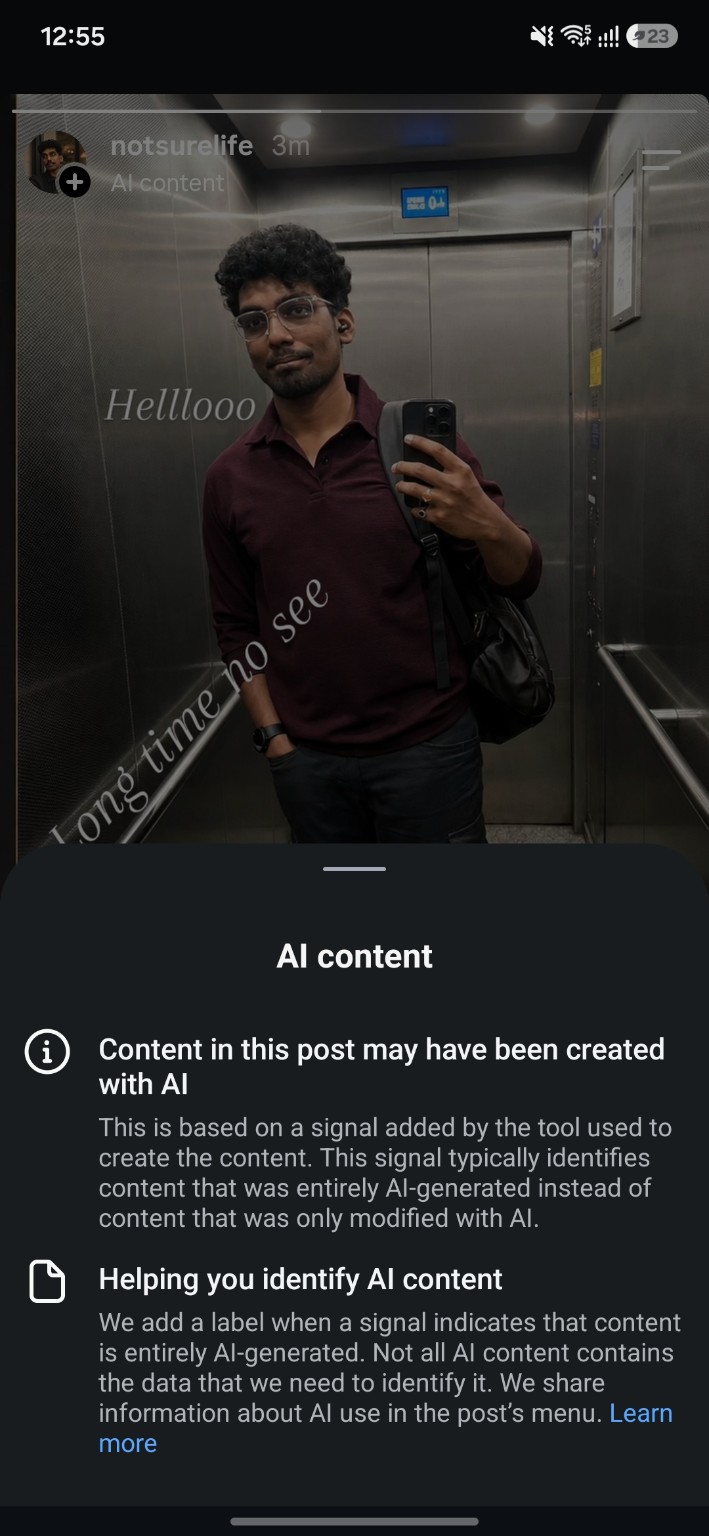
The label that sent me down the rabbit hole.
My first assumption was the obvious one: Instagram must have some giant AI detector running behind the scenes.
Upload image. Scan pixels. Spot an uncanny face or suspicious texture. Label it AI.
That explanation made intuitive sense.
It was also the wrong mental model.
The image was carrying its own receipt
The file I uploaded was not just a bunch of pixels.
It was carrying information about how it had been created.
Think of it less like a detective examining a forged signature, and more like finding a signed receipt inside the envelope.
One of the systems behind this is C2PA, often surfaced as Content Credentials. It lets a file carry a cryptographically signed record of its origin and creation history: which tool created it, what actions were recorded, and whether that record can still be verified.
I checked the image I had generated. Its provenance information pointed back to OpenAI's image-generation pipeline and identified the final asset as algorithmically generated.
Suddenly the Instagram label made sense.
Meta has publicly said that it looks for industry-standard signals such as C2PA metadata when labelling AI-generated media.
Instagram did not need to look at my face and decide I looked suspiciously synthetic.
The file was carrying evidence about its own origin.
Then I started noticing the same idea elsewhere
Once I had seen the label on Instagram, I started paying attention.
I noticed Made with AI indicators on X too.
That is where this stopped looking like an Instagram feature and started looking like a much larger shift.
X says it has expanded "Made with AI" labels for manipulated and AI-generated media in the EU. In India, X also says images generated or edited by Grok, and Grok-generated videos, receive watermarks to support synthetic-content labelling.
The implementations are not identical. One platform may read signed metadata. Another may rely on an embedded watermark. Some may combine those signals with their own detection systems and policy rules.
But the direction is the same:
We are slowly moving from asking, "Does this look AI-generated?" to asking, "What evidence does this file carry about where it came from?"
That is a much better question.
We keep calling three different things "AI detection"
This was the part I had been mixing together.
1. Content credentials
A signed provenance record can tell you that a file passed through a particular tool and record parts of its history. C2PA is one of the major open standards for this.
This is closer to checking a passport stamp than analysing someone's accent.
2. Invisible watermarks
Metadata has a weakness: it can disappear when a file is re-exported, compressed, screenshotted, or passed through another service.
So companies also embed signals inside the content itself. OpenAI, for example, says supported generated images include both C2PA metadata and a SynthID watermark. The watermark is designed to remain detectable through at least some transformations even if ordinary metadata is removed.
Similar ideas can be used for video, audio, and even text.
3. Probabilistic detectors
This is what most of us originally imagine: another model looks at the content and estimates whether AI probably made it.
Useful sometimes? Sure.
Proof? No.
It is still an inference, and it can be wrong.
A provenance signal is evidence about origin. A detector score is a guess based on patterns.
There is still a big hole in the system
Here is where the simple "AI can now be detected" story falls apart.
Suppose I screenshot an AI-generated image. The screenshot may lose its original metadata. A durable watermark might survive, or it might weaken. Or the image may have come from a model that never added either signal.
What should a platform conclude then?
Nothing definitive.
A trusted signal can be strong evidence that a supported AI system was involved.
No signal does not mean a human made it.
It may simply mean the evidence is gone, degraded, unsupported, or was never there in the first place.
And provenance has another important limit: it does not tell you whether the content is true.
A signed record may help tell you where an image came from. It cannot tell you whether the claim made with that image is accurate, whether the uploader owns it, or whether it has been taken out of context.
Origin and truth are different problems.
The product question I couldn't stop thinking about
Instagram showed me a binary label: AI content.
Useful, but it immediately created more questions.
Who generated it? Which tool signed it? Was the content created from scratch or only edited? Is the signature still valid? What happened to the file between creation and upload?
And most importantly, if there is no signal, does that mean human or simply unknown?
Most people cannot answer any of those questions while browsing the web.
That feels like the more interesting product opportunity.
Imagine right-clicking an image, video, or document and choosing Inspect provenance.
Instead of another magical "92% AI" score, you would see something closer to:
Origin signal found

Issuer        OpenAI
Signal        Signed Content Credential
Credential    Valid
History       Generated -> Edited -> Exported

What this means
A trusted provenance signal associated with OpenAI was found.

What this does NOT mean
This does not verify that the content is factually correct
or being shown in the right context.
And when nothing trustworthy is found:
No supported provenance signal found.

Result: Unknown

This does not prove the content was created by a human.
That second result is probably the most important product decision.
A useful provenance system has to be comfortable saying I don't know.
If I were building it, I would start much smaller than "detect every AI thing on the internet." V1 would do one job well: take an image, inspect its C2PA credentials, verify the signature, and explain the result in normal language.
Video, audio, text, documents, and provider-specific watermarks can come later.
The value is not another detector.
It is an evidence layer people can actually understand.
Maybe "Can AI detect AI?" was the wrong question
For the last few years, we have been obsessed with figuring out whether a piece of content looks machine-made.
But the more useful internet may be one where content can carry a verifiable history of where it came from and what happened to it.
Cameras can sign what they capture. Editing tools can record what they change. Generative models can mark what they create. Platforms can read those signals. Users can inspect the chain instead of blindly trusting a label.
It will not identify every AI-generated file. It will not solve misinformation. And it definitely will not turn provenance into truth.
But it changes the problem from guessing based on appearance to examining evidence about origin.
And all of this started because Instagram put two small words above a photo I posted:
AI content.
Turns out, the image had been carrying the explanation with it the whole time.